

The Ghost Beneath the Norwood Lateral: Cincinnati’s Abandoned Subway


Every day, thousands of commuters drive over a secret they don’t even know exists. Just beneath the Norwood Lateral and Central Parkway lies one of Cincinnati’s most ambitious, strange, and forgotten projects — a subway system that was never finished.
At a time when cities like New York, Boston, and Philadelphia were tunneling toward the future, Cincinnati decided to join the modern era. A subway line was planned to stretch from downtown to Norwood and beyond, carving through the old Miami & Erie Canal bed. Tracks were laid, tunnels were carved, and hopes were high. Engineers and laborers worked from 1919 to 1925, constructing over two miles of tunnel and several station platforms.
But then, almost overnight, it all stopped.
The answer is part economic collapse, part political infighting — and part ghost story.
In 1916, voters approved a $6 million bond to fund the construction of the new subway. It was a bold move—$6 million then would be over $170 million today. The city envisioned a state-of-the-art transit system that would elevate Cincinnati to the level of its peer cities.
Unfortunately, by the time construction began in 1919, wartime inflation had already started eroding the purchasing power of that money. Material costs skyrocketed. Labor was in short supply. City officials asked for more funding, but political infighting on the city council blocked additional financing. Despite the incredible progress made underground, the project ran out of money by 1925.
Then came the final blow: The Stock Market Crash of 1929 and the onset of the Great Depression.
Any lingering hope of finishing or repurposing the subway died as the economy collapsed. Tax revenue plummeted, unemployment soared, and survival—not transit—became the city’s focus. The subway, still incomplete, was officially abandoned in the early 1930s. Learn more about how the Great Depression impacted public works at History.com.
What’s left behind is a massive ghost of a project—an entire transit system built beneath our feet but never used. Many Cincinnatians don’t even realize that as they drive along the Norwood Lateral, they’re passing over these forgotten tunnels. In fact, several locations still house sealed-off entrances and bricked-up platforms, including visible remnants near Hopple Street and Ravine Street.
Though discussions of reviving the tunnels have emerged over the years—from light rail proposals to underground walking tours—nothing has ever stuck. The costs are high, the vision uncertain. But the fascination remains. The Cincinnati Subway is considered one of the largest unused subway systems in the United States . The ghost beneath the Norwood Lateral may never come back to life—but it still has a story to tell.
The Vision: Why Cincinnati Wanted a Subway
In the early 1900s, Cincinnati was booming. As one of the Midwest’s most important river cities, its neighborhoods stretched into the hills, while its commerce and culture flowed through the dense basin below. But with all this growth came a major challenge: congestion. Streetcars rattled along narrow roads, carriages and early automobiles clogged the streets, and downtown Cincinnati was frequently gridlocked.
City planners knew something had to change. Traffic was slowing commerce, limiting mobility, and making daily life more frustrating for the working class and business elite alike. The city needed a solution to keep up with modern urban growth—and they found it underground.
By 1910, the idea of a subway system had already started to take root in the public imagination. Urban planners and engineers looked to New York, Boston, and Philadelphia, where subway systems had been successfully implemented to revolutionize city travel. Could Cincinnati do the same? Public officials believed it could—and more importantly, so did the public.
By 1916, the need for mass transit had become too urgent to ignore. That year, Cincinnati voters approved a $6 million bond to build a state-of-the-art rapid transit system. Adjusted for inflation, that’s about $180 million today—an incredible sum that demonstrated the city’s confidence in the vision.
The plan was ambitious. Engineers proposed building the subway in the abandoned bed of the Miami & Erie Canal, which had once served as a vital shipping route. By repurposing the canal route, the city could reduce land acquisition costs and minimize disruptions to above-ground traffic during construction. It was a smart, strategic approach that gave Cincinnati a head start.
The system was designed to connect downtown to Norwood and beyond, with underground tunnels, elevated sections, and future branches planned into key neighborhoods. It would ease pressure on surface streets and link commercial centers with emerging suburbs.
Cincinnati wanted to lead the way into the future. This wasn’t just about trains—it was about transforming how the city moved.
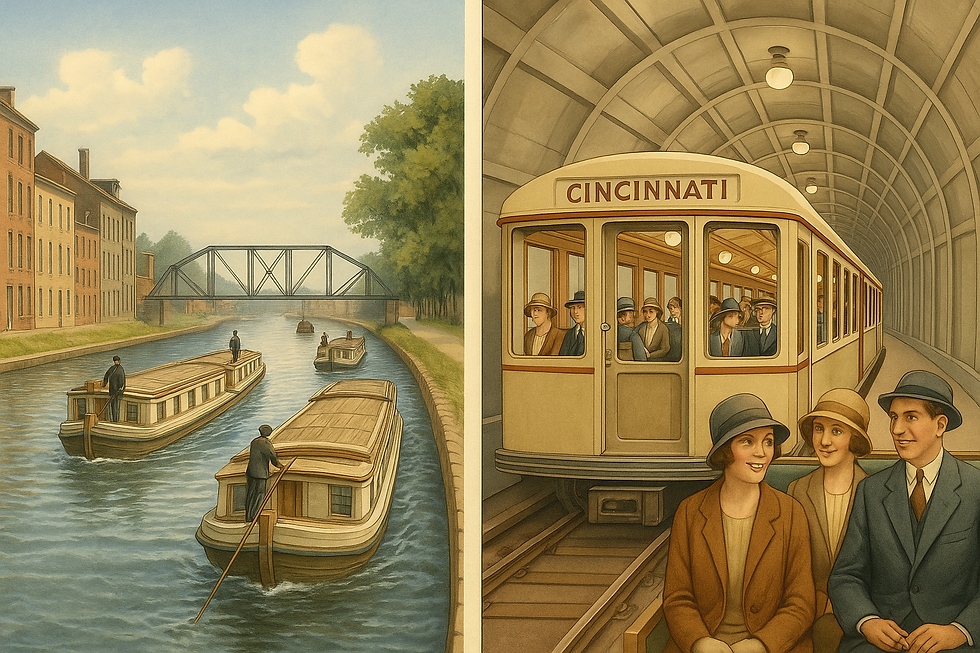
Unfortunately, the dream that seemed so achievable in 1916 began to unravel in the years that followed. Inflation, political disagreements, and—eventually—the Great Depression would derail progress. But at the time, spirits were high. The city truly believed it was building the next great American subway.
To this day, the story of Cincinnati’s subway is more than just a tale of lost tunnels—it’s a reminder of the boldness, hope, and civic pride that once defined the city’s vision for the future.
How the Plan For The Cincinnati Subway Took Shape: 1910s–1920s
Once voters approved the $6 million bond in 1916, Cincinnati moved quickly to bring the subway vision to life. With a clear route, a detailed plan, and early engineering advantages, the project seemed destined for success.
The city selected the old Miami & Erie Canal bed as the foundation for the route. Long obsolete, the canal had once carried goods through the heart of Cincinnati but had since become a stagnant, unused scar cutting across neighborhoods. Using it for subway construction made sense—it was already excavated in many sections, city-owned, and ran through the exact corridor planners needed.
Construction officially began in January 1920, and the momentum was immediate. Engineers designed a 16-mile system with plans for:
16 total stations
Double-track tunnels beneath what would become Central Parkway
Stops and service for Downtown, Norwood, St. Bernard, and the West End
Future potential expansions to Oakley, Evanston, and even Clifton
By 1923, major segments of the tunnel were taking form. The largest completed section stretched from Walnut Street to Hopple Street, a significant downtown span that included multiple future stations. Concrete-lined tunnels were reinforced with steel. Ventilation shafts were dug, essential for circulating air in a steam-free, electric-powered system. Station staircases were framed in, and the city’s early vision was beginning to look like a real subway.
But while the bones of the system were built, the lifeblood was missing. Due to the rapidly rising cost of materials after World War I, the original bond money began to dry up. Essential components like rail tracks, power lines, lighting, and trains were never installed. What Cincinnati ended up with by 1925 was a shell—a massive subterranean corridor with potential, but no function.
At street level, the newly built Central Parkway was designed to sit directly above the tunnels. It became one of Cincinnati’s most significant infrastructure redesigns, reshaping traffic while concealing the project’s deeper purpose below. In some ways, it masked the failure to complete the system.
Many of the planned stations had stairways already built from the street down to the tunnel level, sealed off from the public. These included sites near Ravine Street, Brighton Place, and Mohawk—neighborhoods that were eager for connectivity.
While some Cincinnatians saw the rapid construction and expected full operation within a few years, officials quietly struggled to patch together additional funding. But with no federal transit support in that era and continued political gridlock at the city level, the effort fell short.
Still, the engineering was impressive. The tunnels were well built and designed to withstand decades of pressure and use. And in fact, many still exist today, nearly a century later, remarkably well-preserved beneath modern traffic routes.
The Cincinnati subway plan was taking shape quickly and with confidence. But as the money ran out and the political tides shifted, that shape never became substance. The city had built the body—but never found the power to bring it to life.
The Subway That Almost Was: Routes, Maps & Entrances
What makes the story of the Cincinnati subway so haunting isn’t just that it failed—it’s that it came so close to success.
By 1925, much of the tunnel system was structurally complete. Concrete walls, curved ceilings, and support shafts had been constructed with precision. The double-track tunnel system extended from Walnut Street to Hopple Street, with branches set to serve Downtown, the West End, Norwood, and St. Bernard. Some staircases to station platforms had even been installed, tucked away beneath sidewalks, ready for riders that would never come.
But with the budget drained and political will drying up, the project was abandoned before it could be electrified or put into operation. Tracks were never laid. Lighting and ventilation systems were never activated. Trains never arrived. And yet, the bones of the system remain.
Visible Remnants
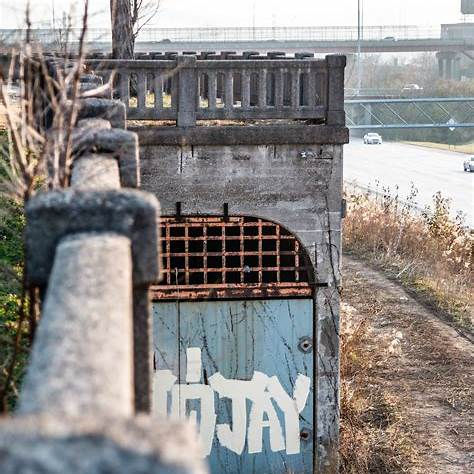
The Brighton Place entrance is perhaps the most famous remnant of the Cincinnati subway.
Still visible today near Central Parkway, it offers a ghostly window into what could have been. Graffiti now marks its walls, but the structure stands as proof of how far the city got before giving up.
Underground stairwells to now-inaccessible platforms still exist, particularly in the Brighton
and Mohawk areas. Sealed off and forgotten, these passageways offer eerie time capsules of 1920s infrastructure frozen in place.
Some sections of the tunnel were repurposed for underground utilities. In later decades, water lines and communication cables were routed through the unused subway shafts, giving them at least some functional value.
Maps and Missed Expansion
Original route maps show a loop running up through Norwood and potentially extending to Oakley and Hyde Park, with future branches envisioned for Clifton and Evanston. These plans were never executed, but the documents remain, reflecting a bold vision that was both ambitious and feasible at the time.
Today, those unbuilt extensions live only in archives and engineering blueprints, a reminder of the potential buried beneath our feet.

Despite never seeing a single train, the Cincinnati subway system remains the largest unused subway network in the U.S. Its unfinished state, partially visible and partially buried, adds to the mystique that has captivated locals, historians, and urban explorers for decades.
So—why did the Cincinnati subway fail?
It wasn’t just one thing. It was a perfect storm of misfortune, mismanagement, and bad timing.
World War I Delays and Soaring Costs on the Cincinnati Subway
After voters approved a $6 million bond in 1916 to fund construction, the city hoped to build quickly. But World War I interrupted labor and material supplies, delaying the project’s start until 1920.
By the time construction began, inflation had spiked dramatically. The bond, which once promised to cover an entire subway system, could now barely fund the basic concrete tunnels. Costs for steel, cement, and labor nearly doubled. What should have bought a fully operational transit system instead delivered only unfinished shells—no rails, no electricity, no trains.
The Great Depression: A Final Blow
Even before the crash, city leaders struggled to secure additional funding. There were debates over priorities, concerns about debt, and fights over how the subway would be run.
Then came Black Tuesday in 1929. The stock market collapsed, and with it, any remaining hope of finishing the subway. The Great Depression slashed tax revenue, decimated city budgets, and left infrastructure projects across the country in limbo. In Cincinnati, the subway was quietly pushed off the
agenda in favor of economic survival.Learn more about infrastructure impacts during the Great Depression
Political Gridlock and Mismanagement
Even with economic factors at play, poor leadership played a key role. Infighting among city officials made it nearly impossible to pass new funding measures. While some local leaders championed the subway, others prioritized highways, utilities, or park systems.
Without strong public advocates or consistent leadership, the subway project simply stalled—and no one had the political capital to restart it.
By the early 1930s, the Cincinnati subway was officially abandoned. Over the decades, several attempts were made to revive it. A few local politicians proposed converting the tunnels into light rail or reactivating service—but none gained traction. No serious funding, federal assistance, or unified citywide support ever emerged.
Today, the collapse of the Cincinnati subway is a cautionary tale. It reminds us how big visions can be derailed by forces far beyond engineering. And how a city’s best-laid plans can still end up buried beneath its streets.
What’s Left: Hidden Entrances, Sealed Tunnels & Lost Time
Today, parts of the tunnel system still exist. Urban explorers have found sealed doorways and old staircases. Some infrastructure is still maintained by the city, mostly for stormwater drainage or access.
Several places where you can still feel its ghost:
Brighton Place entrance
Central Parkway medians (where air vents and sealed staircases still stand)
Underneath the old Western Hills Viaduct
Secrets from the Underground: Urban Explorers, Rumors & Legends
It’s one thing to read about the Cincinnati subway system in history books. It’s another thing entirely to stand in the tunnels—surrounded by silence, darkness, and the weight of a century’s worth of failure.
Though officially sealed, the tunnels have never truly rested. Over the decades, a few daring urban explorers, photographers, and thrill seekers have found their way inside. What they’ve encountered ranges from the eerily mundane to the deeply mysterious.
Some describe nothing more than cold air, pitch-black silence, and leftover debris. Others, however, tell of echoes that seem to reply, strange sensations of being watched, and the kind of lingering energy that only abandoned spaces can hold.
What Explorers Have Found
Despite the risks of injury, arrest, or collapse, the tunnels have drawn the curious since the mid-20th century. Those who’ve entered often share similar discoveries:
Odd acoustics: Some areas within the subway generate strange, bouncing echoes. Footsteps feel amplified, and whispers carry far beyond reason. The environment, made entirely of concrete, acts like a massive reverb chamber—distorting sound in unnatural ways.
1920s relics: Explorers have found rusted wheelbarrows, sections of scaffolding, and handwritten construction notes left on crumbling walls. One report mentions a dusty crate filled with old electrical wire spools, untouched since the project halted.
Graffiti and shrines: Modern explorers have added their own marks—graffiti ranging from artistic to chaotic, often paired with makeshift shrines, candle stubs, and haunting murals. Some believe these are acts of memorial for a city’s lost ambition.
Rumors & Legends
What would a century-old abandoned subway be without ghost stories?
Urban legends surrounding the Cincinnati subway are surprisingly persistent. Some tell of phantom workmen, supposedly seen crouching near old platforms before vanishing. Others claim they’ve heard metal dragging sounds or distant whispers with no source. There’s no documented tragedy tied directly to the subway’s construction, but that hasn’t stopped speculation. Many locals believe the very nature of the tunnels—sealed, forgotten, unfinished—is what gives them their haunted reputation.
In particular, the Brighton Place entrance, still visible from Central Parkway, is often cited in stories. It’s become a kind of pilgrimage site for paranormal enthusiasts and night photographers hoping to catch something unexplained on film.
Whether or not you believe in ghosts, the psychology of the space is undeniable. A dark, unused space beneath a living city invites myth. When combined with 100 years of silence and mystery, it's no surprise the Cincinnati subway has become a breeding ground for folklore.
Forbidden Exploration
It’s worth noting: exploring these tunnels is illegal and dangerous. Over the years, the city has increased security, added reinforcements, and sealed known entrances. Some areas contain collapsed sections, live utility lines, or structural instability. Still, the myths persist—and the subway remains a symbol of unfinished dreams, wrapped in shadow and silence.
The Cincinnati subway wasn’t just a failed transit system—it became a stage for imagination, a blank slate where history, mystery, and storytelling meet. Whether it’s echoes of construction past or something more spectral, the secrets of the underground continue to echo just below our streets.
Why It Hasn’t Happened
Despite the creativity, every plan has hit a wall.
The primary issue is cost. Refitting the subway tunnels for modern safety and accessibility standards would cost tens, possibly hundreds, of millions. Engineers would need to address ventilation, structural updates, lighting, water damage, and ADA compliance. And that’s before adding trains, platforms, or museum exhibits.
Logistics are another obstacle. Some parts of the tunnels are now used for water and utility infrastructure, complicating access and rerouting possibilities. Other sections were damaged during the construction of highways like the Norwood Lateral in the mid-20th century.
Then there’s public opinion. Cincinnati voters have repeatedly rejected large transit funding packages over the years. In a car-centric region, it’s proven difficult to rally widespread support for a rail revival—especially for one buried underground.
Still, the Dream Lives On
Despite the hurdles, the Cincinnati subway isn’t entirely forgotten. It still appears in transportation studies, architecture school projects, and even startup brainstorms. It’s part of the city’s collective memory, and its untapped potential continues to inspire.
As of 2025, there’s no formal plan to revive the subway, but interest remains. And if Cincinnati ever makes a major investment in public transit, there’s a good chance the old tunnels will come up again—waiting in the dark.
"Did You Know?" Sidebar Facts
Cincinnati’s abandoned subway is the largest in the U.S. that never carried a single passenger.
Some tunnel walls are 18 inches thick and reinforced with steel.
At one point, city leaders considered selling the tunnel space as wine cellars.
The total original route would have covered nearly 16 miles.
Some maintenance workers still have limited access via sealed hatches.
What Else Is Hiding Beneath the Surface?
This story is just one part of what we’re building. Wayback Tours is developing a first-of-its-kind app that brings forgotten history to life as you drive—no maps, no detours, just immersive stories delivered right where they happened.
Curious what it might look like?
You’ll get a sneak peek at the vision behind Wayback Tours—then, before you go, you’ll have a chance to sign up for progress updates and early access.
No spam. Just stories worth the ride.


Comments